
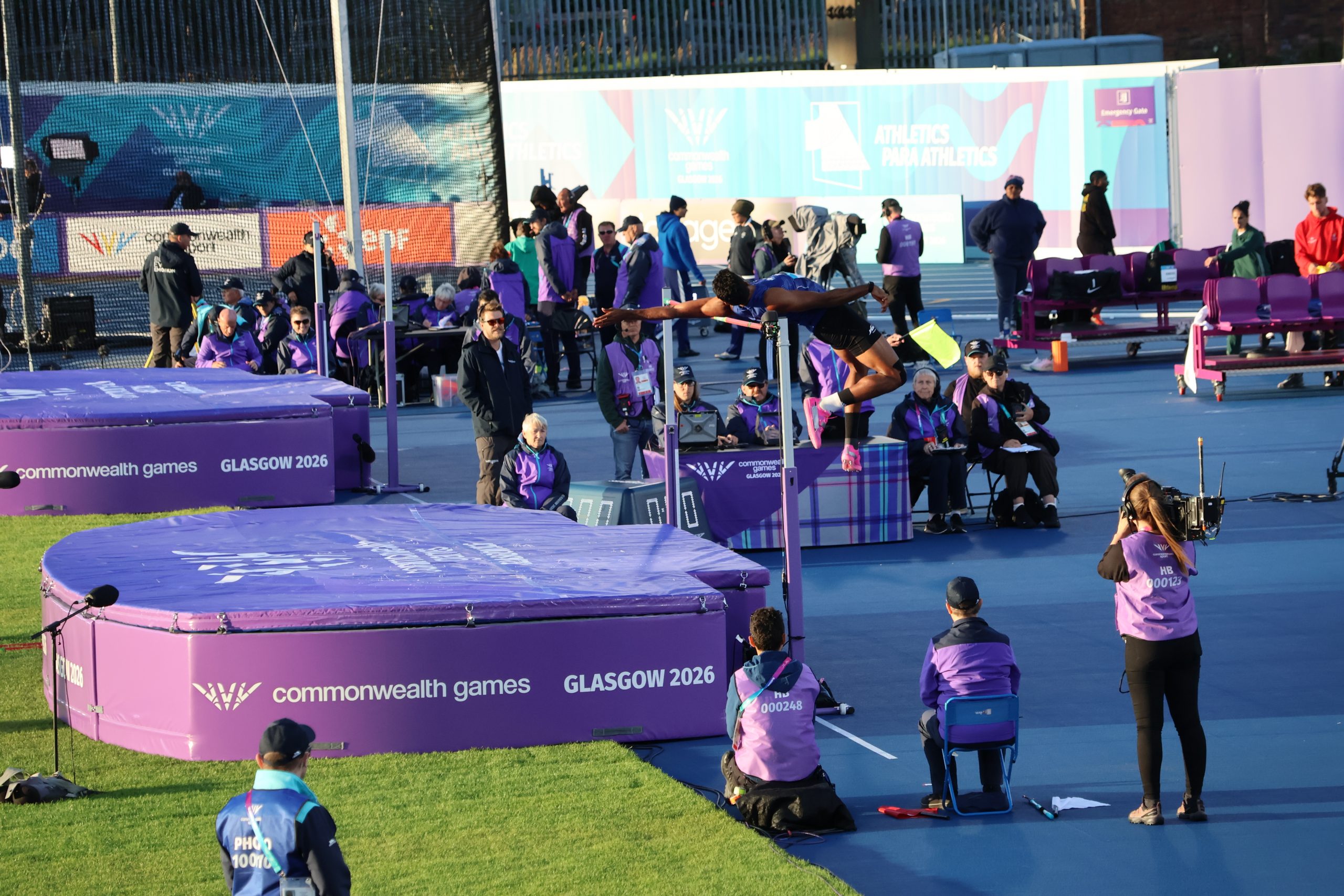
High Jump
After a windy first morning session of the Commonwealth Games decathlon, the decathletes emerged back into the evening sunlight of Scotstoun, to the strains of “Danny Boy”.
Kate O’Connor was being awarded her gold medal for the heptathlon, for Northern Ireland, alongside silver medallist Jade O’Dowda for England, and bronze medallist Tori West for Australia.
The small field, just twelve, was split into two groups. Most of the field had bests between 1.95m and 2.05m, a compact range of heights with little scope for major problems unless points were tight.
Outwith that scope sat two athletes. Max Teuruaa of the Cook Islands had the lowest PB height, of 1.78m, and so would likely be done and dusted before most of the field entered.
At the other end of the scale, TJ Shankar has a PB of 2.29m, and has jumped 2.26m already this year. Most of the field would have likely had their final three attempts before he even entered the competition.
Teuruaa had a good run all the way through to 1.76m. He had three good attempts at what would have been a new lifetime best of 1.79m, but was the first to exit the competition, at 1.76m.
After a third attempt clutch jump at 1.85m, Callum Newby of Scotland cleared 1.88m at the first attempt but failed at 1.91m. That was a little disappointing for the Scot, who would have wanted to jump nearer to 2m.
More significantly, Lindon Victor of Grenada crashed out at 1.88m, having passed at 1.85m. After a third failed attempt at 1.88m, his frustration at leaving with a best of only 1.82m was visible as he rolled off the high jump bed.
For most others in the field, two metres was the height at which they began to tip like dominoes. Jami Schlueter of Nigeria, Sammy Ball of England, Damian Warner of Canada and Lewis Church of England all failed to clear two metres and retired with a best of 1.97m. For a few, an initial clearance came with a late, dramatic drop of the bar, so each clearance was met with a pause, just a moment, to ensure the clearance stuck.
So as the field thinned out, two men were left, one in each group.
Evan Campbell, and TJ Shankar. The athlete from Jersey, and the top decathlete high jumper in the world.
Both cleared two metres, and for a moment, both men had collected the same number of points from the event. Close to his PB of 2.03m, that was Campbell’s best of the evening.
So now time for Shankar to build points. Like Simon Ehammer, having a world class individual event can come in very useful to provide a buffer for the weaker events later in the competition.
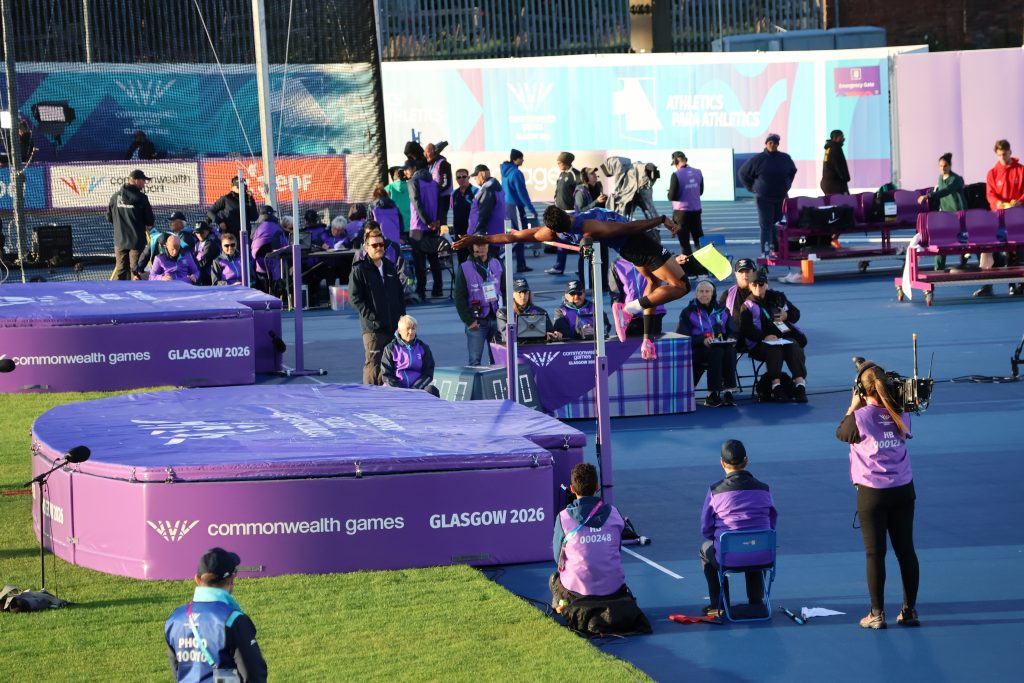
Shankar sailed over 2.06m and passed at 2.09m.
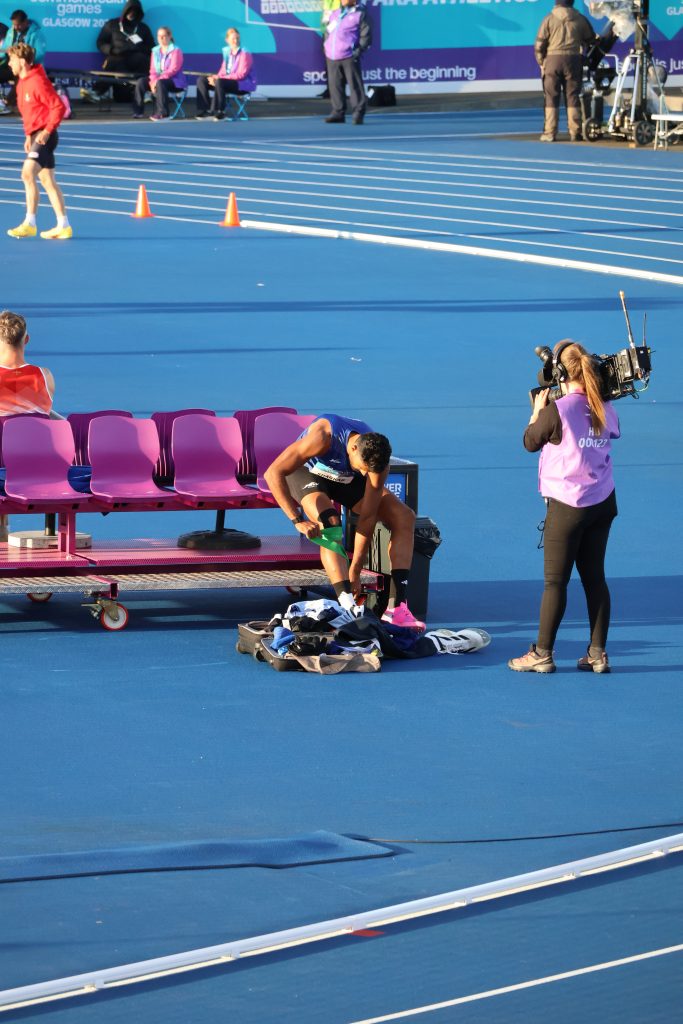
He attempted 2.12m, but at his first failure, something was clearly wrong. Shankar had retired early from the individual high jump competition, telling Indian media:
“In my second jump, I felt a shooting pain in my knee. It’s not a new injury, but I’ve always had tendonitis in my knee. I decided to stop after my first jump. I don’t want to ruin the next event that I have.”
We then saw some tactical jumping, from Shankar, which is unusual in decathlon.
Rather than continue with attempts at 2.12m, he took his “second” attempt at 2.15m and cleared it. He then took two attempts at 2.18m, before using his third attempt to try at 2.21m.
In combined events, there is no countback penalty. It doesn’t matter whether you cleared a height on the first, second or third attempts – the points are the same. The only difference is the fatigue in the legs from the multiple attempts.
Very rarely, a decathlete will go for broke for a higher height in the pole vault with their second or third attempt, if a gamble is the only route to a medal. The high jump is, however, too early in the competition to risk losing points.
So why did TJ spread out his attempts? The short answer – to get as high as possible with as few jumps as possible.
When your best is 2.29m, you can have some confidence that you can clear heights 10-15cm below that. So using his attempts to skip through heights from 2.12m to 2.21m saved the load on his injured knee.
The gamble didn’t pay off entirely, and he landed at the sort of heights a Garland, Baldwin or Skotheim might produce. But 2.15m was still 15cm clear of the next athlete, and very useful points on the scoreboard.
After four events, Lindon Victor and TJ Shankar swapped places. Shankar moved from fifth to second, while the reigning champion dropped from second to fifth.
- Damian Warner (CAN) 3541
- TJ Shankar (IND) 3502
- Sammy Ball (ENG) 3381
- Jami Schlueter (NGR) 3368
- Lindon Victor (GRN) 3329
- Lewis Church (ENG) 3207
- Callum Newby (SCO) 3203
- Evan Campbell (JER) 3088
- Joel McFarlane (SCO) 3069
- Max Attwell (NZ) 3044
- Edwin Too (KEN) 2965
- Max Teuruaa (COK) 2709
400m
The final event of the first day was all about the Scots.
In the second heat of the 400m, Callum Newby and Joel McFarlane came around the final bend in a heather-shaded blur, step for step in the two inside lanes and finished first and second, to the delight of the home crowd.
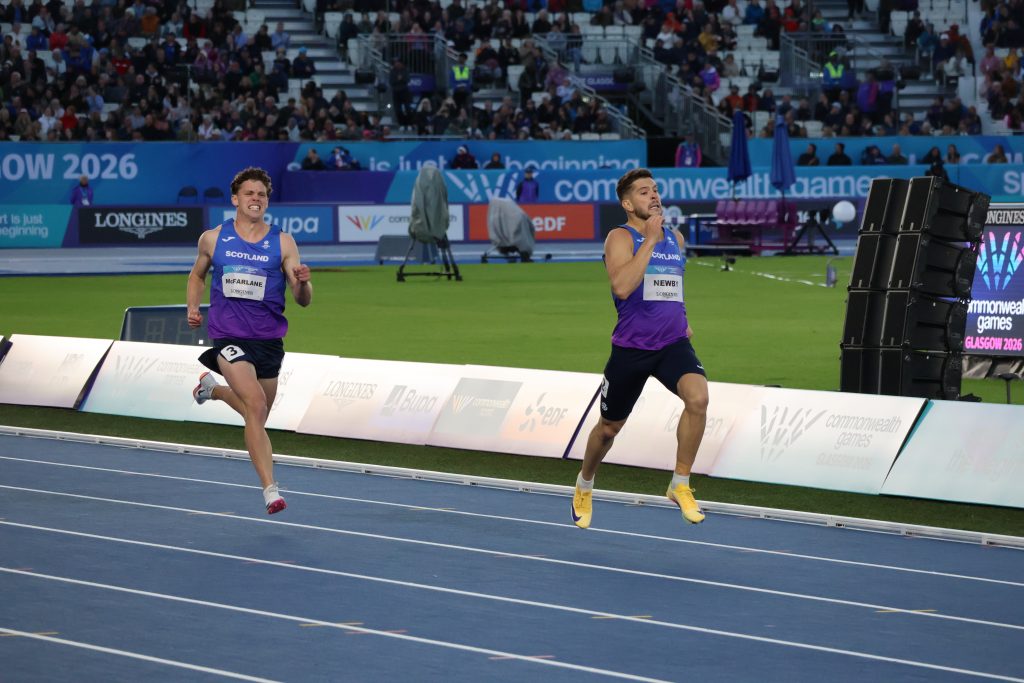
Newby, the slower of the two on paper, pulled away in the home straight and scraped several hundredths off his lifetime best, reducing it from 48.63s to 48.59s. McFarlane was next in 49.3s.
The two were separated in the overall results for the discipline by Sammy Ball’s solid run of 48.86s in the first heat, but the runs improved their overall standings. Newby moved up from seventh place to sixth, and McFarlane from ninth to eighth.
The placings above the Scots did not change, but the gaps narrowed. Shankar had been 39 points behind Warner after the high jump, but the Indian reduced that to only 14 points after running 49.51s to Warner’s 50.05s.
Sammy Ball reduced the gap between himself and Shankar from 121 to 90.
After the first day of competition, it was tight at the top.
- Damian Warner (CAN) 4353
- TJ Shankar (IND) 4339
- Sammy Ball (ENG) 4249
- Jami Schlueter (NGR) 4196
- Lindon Victor (GRN) 4171
- Callum Newby (SCO) 4084
- Lewis Church (ENG) 3943
- Joel McFarlane (SCO) 3916
- Max Attwell (NZ) 3849
- Evan Campbell (JER) 3743
- Edwin Too (KEN) 3726
- Max Teuruaa (COK) 3435
110m hurdles
After a relatively drama-free first day, the second day of competition brought disaster for several athletes, in different ways.
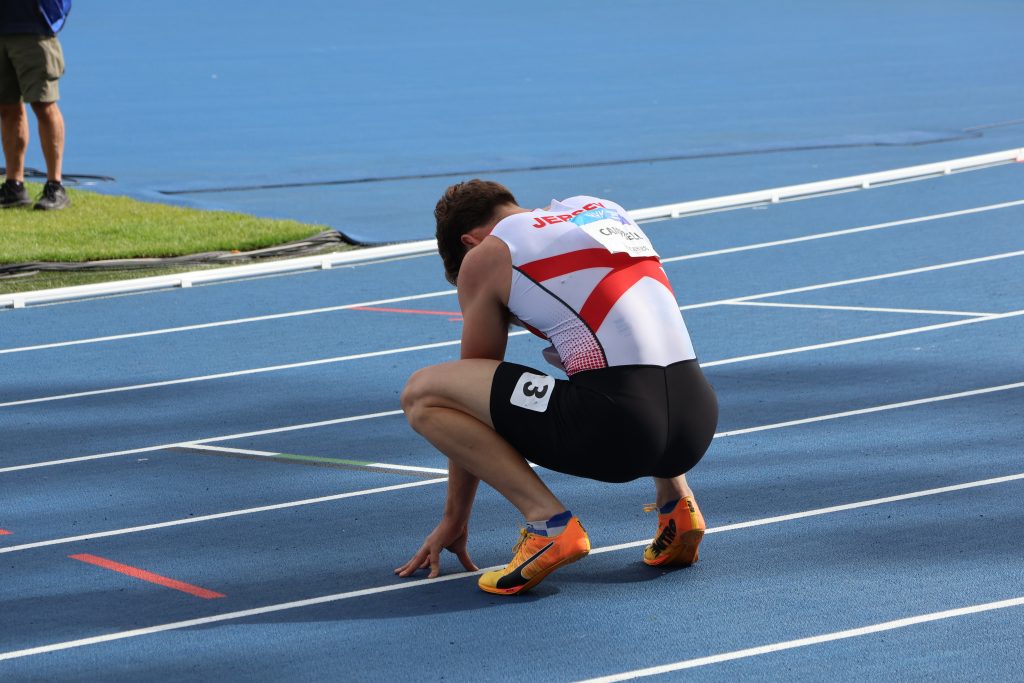
The most brutal impact came for Evan Campbell, who fell early on in his heat. He got up, finished the race, and carried on, having worked too hard to make it to the Games wearing the Jersey colours to admit defeat.
In the same heat, Lindon Victor finished the race, but haemorrhaged points, running only 15.67s.
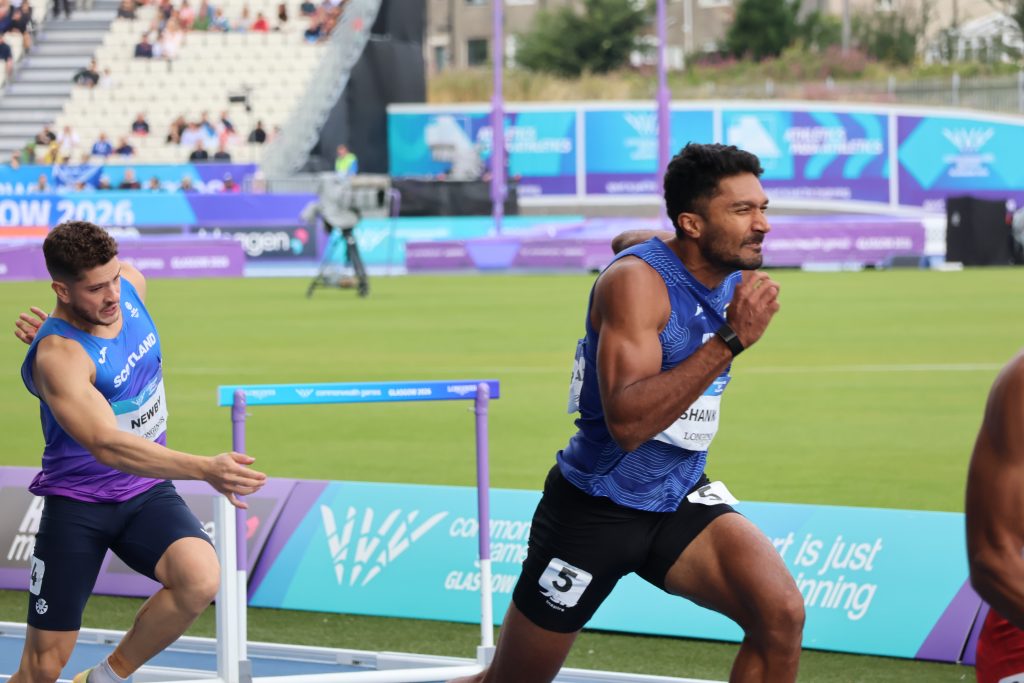
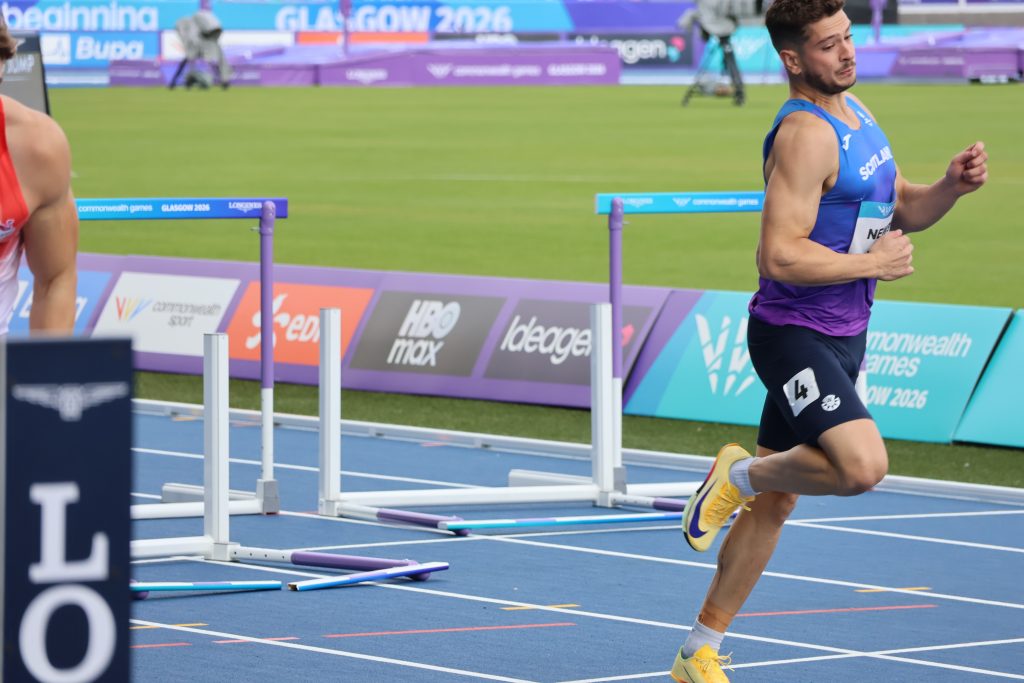
In the second heat, Callum Newby almost suffered a similar fate to his training partner Campbell. Losing his rhythm, he stumbled through several hurdles in the second half of the race and then broke the horizontal of the final hurdle as his foot struck it. Newby lost his balance, lurching wildly, but had enough momentum to recover and run through the line. His time of 15.02s, while way down on what he would have wanted, was in the end still the sixth best of the morning.
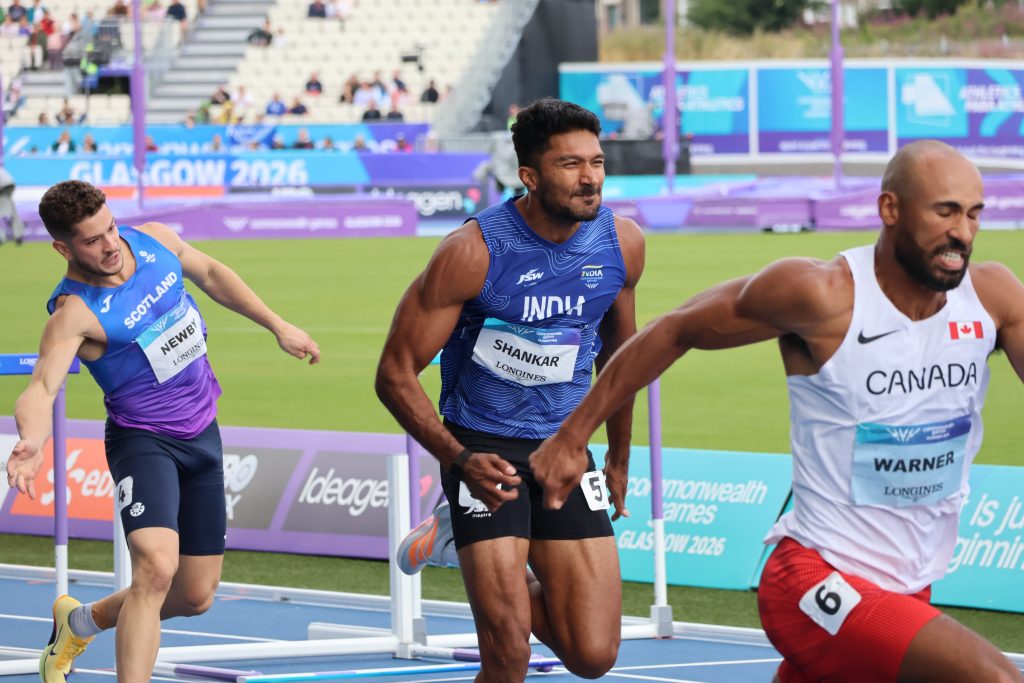
The more subtle blow was for Damian Warner. He finished first, and four tenths ahead of anyone else, so that’s good, right?
No, it wasn’t. This is where the nuance of combined events comes into play. The athletes aren’t trying to win a heat or finish ahead of someone else in a race, or at least that’s not their primary objective. They are trying to extract the maximum number of points for their own performance.
And a run of 14.04s for Damian Warner is very far from the performance, and suite of points, he would expect to extract from the 110m hurdles. For context, he ran 13.76s in Götzis, which was in itself slower than expected.
So despite finishing first, this was not a good event for Warner. Yes, it extended his lead by 47 points. But usually his hurdles points are what put him out of reach of everyone else. On this occasion, the points leave the 2021 Olympic champion vulnerable.
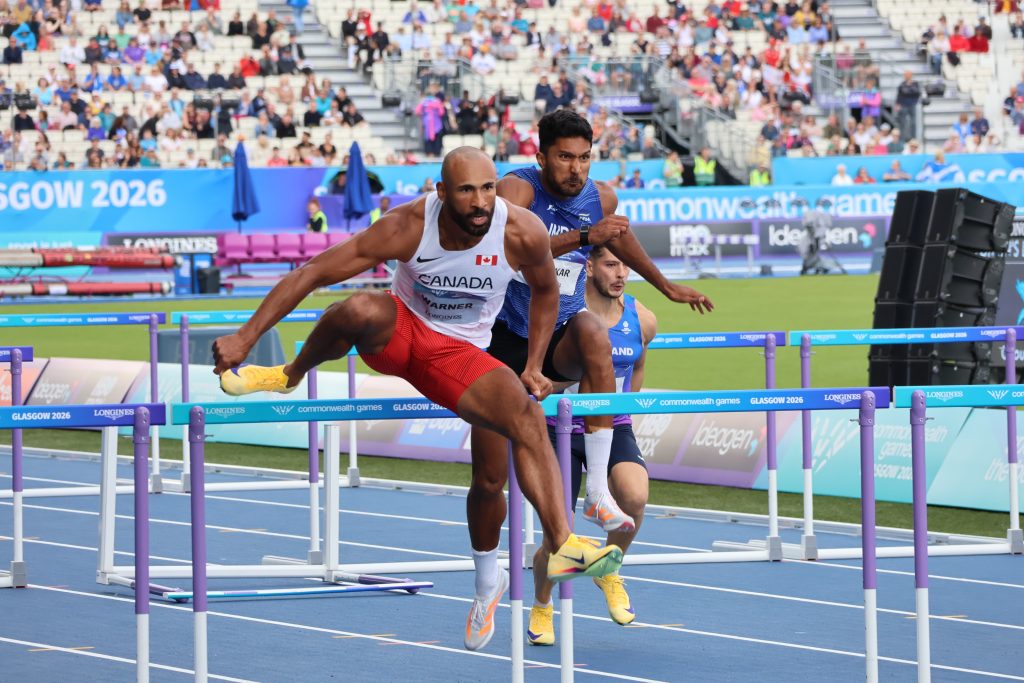
Shankar had a solid run of 14.41s, but the best performances came from Lewis Church and Sammy Ball. Although the wind was marginally over the legal limit for individual record purposes (+2.2), they both ran slightly faster than their PB times, 14.43s for Church and 14.61s for Ball.
Where Warner lost advantage, the English gained momentum.
After six events:
- Damian Warner (CAN) 5322
- TJ Shankar (IND) 5261
- Sammy Ball (ENG) 5146
- Jami Schlueter (NGR) 5099
- Lindon Victor (GRN) 4941
- Callum Newby (SCO) 4931
- Lewis Church (ENG) 4863
- Joel McFarlane (SCO) 4653
- Max Attwell (NZ) 4560
- Edwin Too (KEN) 4469
- Max Teuruaa (COK) 4176
- Evan Campbell (JER) 3743
Discus
By the time the seventh event arrived, it was clear that all was not well with Damian Warner. Canadian media reported that he was suffering from cramp on day one, particularly in his biceps.
That played through in the discus. Warner, usually in the high 40s, could not get beyond 38m, throwing 37.61m, 37.40m and a foul.
After the long jump, the Canadian had had a cushion of 153 points to his nearest rival. The gap was slowly whittled down event by event, to 80 after the shot, 39 after the high jump, to its narrowest at 14 after the 400m. The boost which would normally come from the hurdles only took the lead to 61 points. And it was about to shrink to single figures.
Unusually, the threat didn’t come only from Lindon Victor, who always hops up the standings after the discus. After a false alarm with a mis-measured 56.07m, Lindon’s best was 53.52m, typical for his strongest event. That brought him into third position, 53 points behind Warner. On another day that might have put him into the lead, but with a disappointing high jump and hurdles, Victor was also behind schedule.
Instead, the emerging threat to Warner came from a tiny improvement at the 40m mark.
As a high jumper-turned decathlete, discus was always going to be one of the harder events for TJ Shankar to master from a technical perspective. But he added three important metres to his best during the course of competition. His personal best before the event was 39.28m. He extended that to 39.66m in the second round, and over 40m to 40.44m in the third round. That tiny improvement brought him within three points of the lead.
Now, the other technical event still on Shankar’s to-do list is the pole vault. But with Warner struggling to produce his usual benchmarks, Shankar’s top end of 4.35m might not be the limiting factor it has been to date.
Elsewhere, Callum Newby recovered well from his hurdles scare with a 42.16m PB. He started the competition with the tenth best PB but ended it with the fourth best result overall.
Joel McFarlane had his own scare with two no-throws but rescued his competition with a throw a touch under 40m on his final attempt.
After seven events, the only change in standings was Lindon Victor leapfrogging Jami Schlueter and Sammy Ball into third. But the difference between first and third had concertinaed from 176 points to 53 points, with Ball only another 25 points behind in fourth.
- Damian Warner (CAN) 5938
- TJ Shankar (IND) 5935
- Lindon Victor (GRN) 5885
- Sammy Ball (ENG) 5860
- Jami Schlueter (NGR) 5701
- Callum Newby (SCO) 5640
- Lewis Church (ENG) 5605
- Joel McFarlane (SCO) 5315
- Max Attwell (NZ) 5214
- Edwin Too (KEN) 5071
- Max Teuruaa (COK) 4641
- Evan Campbell (JER) 4434
Pole Vault
For a decathlon where there have been almost no instances of disqualification or no-marks (save for poor Evan Campbell in the hurdles) it has been unusually chaotic.
While the numbers underpinning a decathlon usually provide the canvas on which to paint the picture of the evolving scene, whether that be a soothing Monet or a more boisterous Caravaggio, this decathlon has been more of a Jackson Pollock.
It looks nice, it’s pleasing to stare at it, but you have absolutely no clue what is going on.
The only significant thing to happen in the pole vault is that Damian Warner’s troubles continued, with a best of only 4.40m. He was, however, unlucky in his first attempt at 4.50m. He cleared the height cleanly, but his pole tipped onto the bar and knocked it off.
It is tribute to Warner that when his decathlon tips off its axis, it changes the whole balance of the decathlon. Dynamics are emerging which didn’t exist when his influence dictated the flow of points.
Callum Newby was the only 5m vaulter in the field before the competition, and he jumped 5m exactly. Lewis Church and Lindon Victor both cleared 4.70m, an excellent result for Church and a solid one for Victor (especially since he was carrying an injury which was clearly bothering him).
Jami Schlueter and Sammy Ball both cleared 4.60m, good results for both of them. Max Attwell cleared 4.50m. TJ Shankar cleared 4.30m, just short of his best. Joel McFarlane cleared 4.30m, within 20cm of his best. Max Teuruaa equalled his Cook Islands national pole vault record and the crowd sang Happy Birthday to him.
The effect of all of that was for Lindon Victor to move into the lead, and TJ Shankar to drop below Sammy Ball. Callum Newby also moved up into fifth place, and within scent of the podium, although a lot would need to happen for that to become reality. Lewis Church will almost certainly bring a late charge.
This decathlon has the most unusual of dynamics, with this rarely formulated Commonwealth field. It’s a new dynamic, and it’s hard to watch Damian Warner struggle. But with two events to go, it sure is compelling.
- Lindon Victor (GRN) 6704
- Damian Warner (CAN) 6669
- Sammy Ball (ENG) 6650
- TJ Shankar (IND) 6637
- Callum Newby (SCO) 6550
- Jami Schlueter (NGR) 6491
- Lewis Church (ENG) 6424
- Joel McFarlane (SCO) 6017
- Max Attwell (NZ) 5974
- Edwin Too (KEN) 5580
- Max Teuruaa (COK) 5258
- Evan Campbell (JER) 5079
How to support my work: If you enjoyed this report and would like to to support my work, feel free to fuel my coverage with a coffee at ko-fi.com/thedecathlonwriter
WRITTEN BY: GABBY PIERACCINI
