
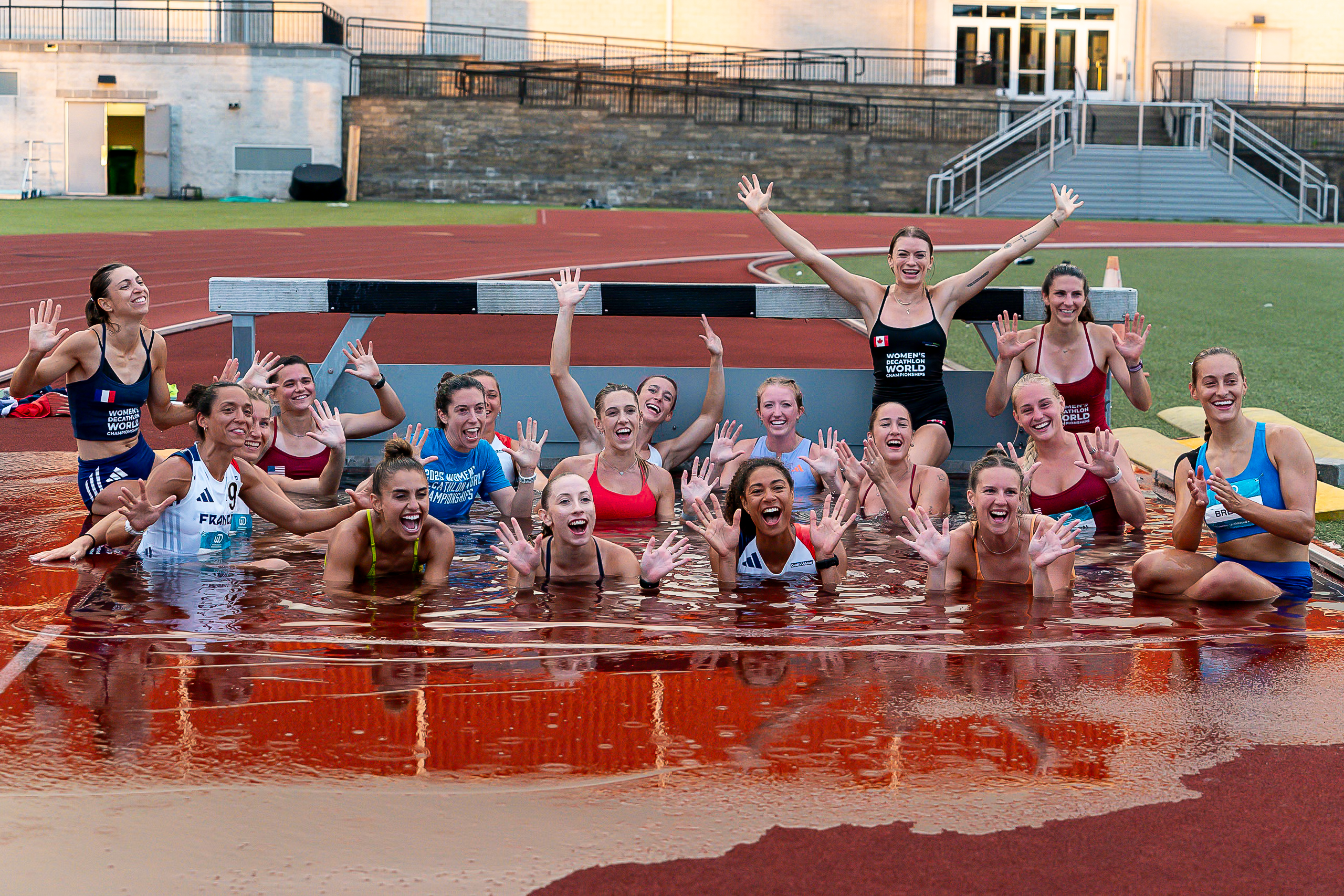
Channelling Alice Milliat with a third “rogue” competition, surviving a last-minute shunt from Trump’s “Patriot” Games, and with Olympic pole vault bronze medallist Holly Bradshaw ready to take the mic, the third Women’s Decathlon World Championships this weekend is bigger and bolder than ever in 2026.
On Friday 7th August 2026, one day before the third edition of the Women’s World Decathlon championships, a timely email dropped into my mailbox.
The email was the latest offering from the Zeus Files, the excellent Olympic sports Substack platform established by Duncan Mackay.
The articles always provide a thought-provoking read, whether they be examining politic manoeuvres in the Olympic movement or delving into a curiosity of sporting history.
On this occasion, the subject matter was the 100-year anniversary of the decision to allow women to compete in athletics in the Olympics, specifically “it was decided to include in the programme of the 1928 Olympic Games, events in athletics sports reserved for women.”
The narrative of the article guides us through some familiar milestones. The “rogue Olympics” organised defiantly by Alice Milliat in the 1920s. The infamous “wretched women” reference later that decade, which would lead to the 800m being dropped from the women’s Olympic programme for another 30 years. And of course, the iconic scenes of Joan Benoit winning the inaugural Olympic marathon for women in 1984.
The piece concludes with the celebration that men and women can now compete in an equal number of events at the Olympics in track and field, noting the 3000m steeplechase as one of the final events to be added to ensure women could finally compete in the same disciplines as men.
Worth celebrating? Absolutely. Can women now compete in the same events as men? Not quite.
There’s one further landmark yet to be reached. In 2026, decathlon is the only track and field discipline where women cannot compete at global championships, the sole remaining inequity.
And so our modern-day Alice Milliats, in the shape of female decathletes, have again organised their own “rogue” world championships.
The Women’s World Decathlon championships
The Women’s World Decathlon championships were established by female decathletes for female decathletes because, in their own words, they were “done waiting for permission” – from World Athletics, from the IOC and everyone else – to give them the opportunity to compete in decathlon. So they organised their own championships.
The first edition of the championships, in 2024, was purposely scheduled to coincide with the Olympic decathlon, shining a light on the ten-event-shaped hole in the women’s Olympic track and field programme.
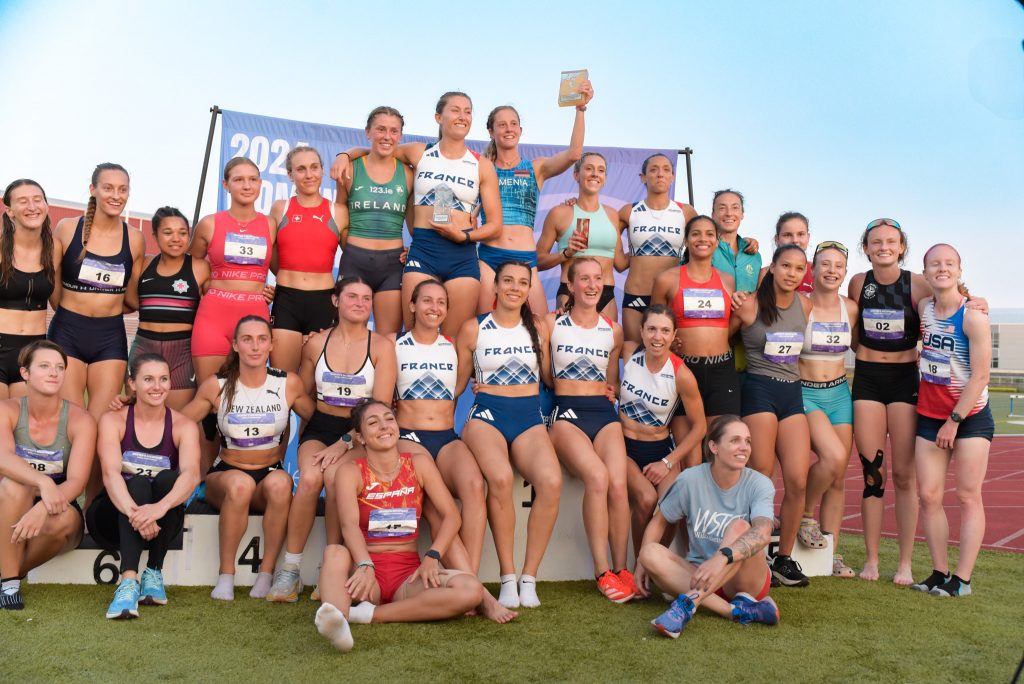
This third edition takes place in a week which coincides with (as reminded by our friends at the Zeus Files) the 100-year anniversary of the vote to permit women to participate in Olympic track and field at all.
Although the competition is not within the World Athletics championships ecosystem – the rogue element – the competition is on the WA calendar and ranked as a category F meeting.
That means it operates to WA rules, and the results will be official and recognised. The only caveat is that the results cannot (yet) be used towards female combined eventers’ ranking, since decathlon is not considered a “similar event” for the purpose of contributing to a heptathlon ranking.
The primary purpose of the competition is, of course, to provide a stage for the best decathletes in the world to compete against each other.
But these championships are also deliberately inclusive in the way that they build a competitive field, with one eye on the current top decathletes, and another on the top decathletes of the future.
Inclusive qualification
Traditional athletics championships qualification routes, by way of a single standard or ranking, don’t work here. The lack of opportunity for women to participate in the event means that it can be challenging for them to even generate decathlon scores.
To help turn aspirations into opportunities, the championships support qualification through four different routes.
The first is an entry standard of 6200 points in decathlon, aimed at established decathletes.
The second is an entry standard of 5000 points in heptathlon, intended to support established heptathletes who would like to try the fuller event.
The third route is the most creative, a minimum number of points across each of a running, throwing, and jumping event, to capture participants with potential across the ten combined events.
Finally, the organising committee is also able to issue individual invitations.
In addition to the main competition, this approach creates valuable, and very visible, pathways for progression, supplementing the field of seasoned ten-eventers with those who have the potential to challenge them, and to together drive the event forward.
These qualification principles also help break the vicious cycle in which female decathletes can find themselves trapped. Few opportunities to compete mean that there is little chance for developing decathletes to progress. That in turn can lead to the self-fulfilling assertion that the sport is not developing, and that there is little demand, and so organisers are not inclined to provide opportunities.
The principles underpinning this unusual world championships have, over the past two years, shown both what could have been and what might yet be possible.
In 2024, elite heptathlete Allison Halverson rounded off her athletics career to win the championships, scoring 7236 in her first decathlon at 31 years old. In 2025, NCAA heptathlete Nikki Boon also won the title with 7451 points on her debut, aged 24, showing what yet might be possible.
What brilliant decathletes might be out there that we will never know about, because they never got a chance to compete?
What might be possible for an athlete who scored 7451 on her first attempt, if only she could train for and compete for the event like her male counterparts?
Where the champs are happening, although they almost didn’t…
Although these championships were a year in preparation, rolling straight on from the previous two editions, an unwelcome development just a few weeks before they were due to take place meant that they almost didn’t happen at all.
Plans were in place for the competition to return to the SPIRE Academy in Geneva, Ohio, the same venue that had hosted the event on both previous occasions.
However, with less than a month to go, the women seeking to compete for the title of the world’s greatest all-round athlete were told that they would have to find another venue to make way for the Freedom 250 “Patriot” Games. Go figure.
Thankfully, nearby Oberlin College stepped in to save the competition, and the event will take place at their venue on Saturday 8th and Sunday 9th of August.
There will be a two-hour programme reviewing the highlights of the first nine events, and showing the 1500m live, on the All Women’s Sports Network at 1800-2000 ET on Sunday 9th August.
You can also find details of “watch parties” on the Women’s Decathlon World Championships website and social media pages.
The athletes participating in the elite decathlon are outlined in the next section.
In addition to the elite decathlon, there will be an Open Girls and Women’s Decathlon taking place, with no qualifying standards.
The women shaping decathlon
Whether on or off the field, the women involved in the championships this weekend are helping to shape the direction of decathlon.
On the field, the line-up is a mix of experienced decathletes, and athletes from individual and other combined events participating in the discipline for the first time.
Significantly, the field also includes two current world-class heptathletes, Australian Olympian Camryn Newton-Smith and France’s Esther Conde-Turpin.
The seasoned decathletes include Noemie Desailly and Roseva Bidois of France, and Jordyn Bruce and Katie Straus of the USA.
Noemie Desailly is a contemporary of French stars such as Auriana Lazraq-Khlass, Louise Maraval and Agathe Guillemot, all of whom competed in combined events before finding success within or beyond those disciplines.
However, the decathlon suits Desailly much better than the heptathlon. She is now the sixth best decathlete in history, having improved her best from 7705 to 7793 points already this year. In France, that’s second only to Marie Collonville, who scored 8150 in 2004.
Desailly competed in pole vault when she was younger, and she brings that strength to the decathlon.
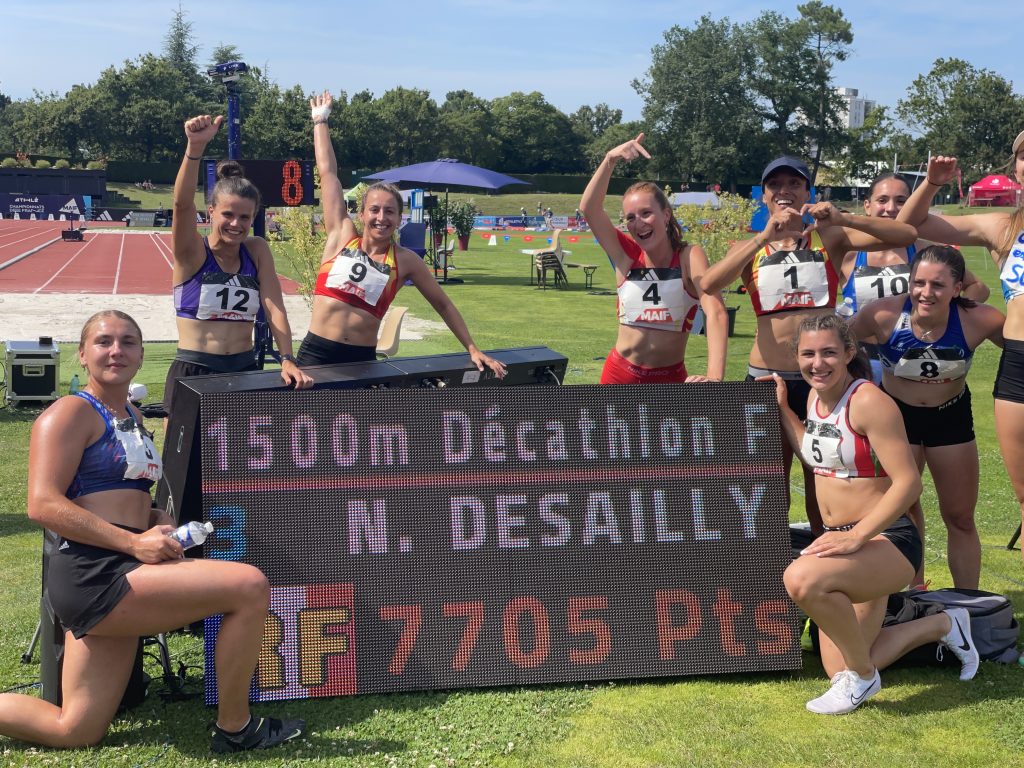
Conversely, her teammate Roseva Bidois brings expertise in the discus, a skill which also cannot be utilised in the seven events of a heptathlon.
Several of the best male decathletes in the world, including 2025 world champion Leo Neugebauer and 2023 world bronze medallist (and newly crowned three-time Commonwealth champion) Lindon Victor, are renowned for the impact their powerful discus throws have on their overall decathlon scores.
Bidois is on a par with good male decathletes in the discus.
Discus is an event where, despite the different weights, elite athletes tend to throw similar distances in both the men’s and women’s events. Bidois’ discus best of 49.76m is therefore at a similar level, and on occasions beyond, what we see in most elite men’s decathlons.
However, one event does not a decathlon make, and Bidois has meticulously built up all the rest of her events to a current PB of 7495, set this year. She won silver at the world championships in 2024 and finished fourth in 2025.
Corinn Brewer, now 22, has been with the women’s decathlon movement since she was at school as a teenager and has a PB of 6850, with a deadly 1500m best of 4:50.24. She can run the 1500m faster than the PBs of some top male decathletes.
Brewer is not alone in having strengths in the middle distance. Several female decathletes also have achievements at the longer end of middle distance, which would be near unheard of in the men’s event.
The female experience of decathlon, particularly in the 1500m, is establishing a perspective very different from the traditional image of giant men lumbering painfully around the track for three and three-quarter laps.
The number two decathlete of all time, Jordan Gray of the USA, reflected on the 1500m in an interview with Decathletes of Europe in 2019. She said, “All the [male] decathletes told me ‘You’re going to hate it. It’s the worst event. It’s the most terrible thing. You’re going to die.’ I went and did it, and I was like, you guys, that was so much better than the 800, I loved it, what are you talking about?!”
Delaney Straus – no relation to Katie – who is competing this weekend for the USA holds her college’s record for the 3000m steeplechase. Perhaps we might find it is the case that female decathletes are generally better equipped to tackle the 1500m than their male counterparts.
The reigning world decathlon champion, Nikki Boon of the Netherlands, returns to defend her title. Boon was able to convert a 5435 heptathlon into a 7451 decathlon. So what might a 6000+ heptathlete be able to achieve?
One of the most interesting dynamics of the competition will be how the world-class heptathletes, Camryn Newton-Smith and Esther Conde-Turpin, fare against the experienced decathletes.
Newton-Smith’s heptathlon best is 6180, although she has struggled with injury this season. On the other hand, Conde-Turpin is in excellent form, scoring 6224 to win the French heptathlon title this year, within six points of her 2018 PB. She qualified for next week’s European Championships in heptathlon, but for the second edition in a row was not given one of the available spaces in the French team.
A taster of how a world class heptathlete might handle decathlon has emerged in the last few weeks from Hungarian heptathlete Xenia Krizsan, who has been a top eight finisher in Olympic, World and European competitions over the last decade.
Although not competing at this championships, the 33-year-old participated in a decathlon in Hungary recently, scoring 7112 on her debut at the event, with little training, and in a season where she has competed in very little else.
The full elite field of 26, from across four continents, is:
- France: Noemie Desailly, Roseva Bidois, Esther Conde-Turpin, Raphäele Rolnin, Adeline Audigier, Suzanne Fournier
- The Netherlands: Nikki Boon, Julia Jongejeugd
- Spain: Uxia Pereira Alonso
- United States: Katie Straus, Jordyn Bruce, Corinn Brewer, Jessica Swalve, Hannah Hill, Madison Luthy, Delaney Straus, Laura Mathews, Alysa Henry, Aubrey Phillips, Elisabeth Eichinger
- Canada: Robin Selkirk
- Mexico: Giselle Burgos
- Australia: Camryn Newton-Smith, Amber Nyssen
- New Zealand: Maria Sartin
- Palestine: Suraia Amer
Decathletes and Ambassadors
For many of the women competing, over and above the weight of decathlon training, they are also tireless ambassadors for the sport.
While not competing this year, decathlete and world-record holder in the double-decathlon Lauren Kuntz is driving the world championships competition forward, on the back of earlier work done by Becca Peter (of Pole Vault Power) and Jordan Gray to establish the discipline as a championship event.
Over and above the execution of the event, Kuntz has helped secure TV coverage and deployed some of the best pre-competition narratives you’ll see in combined events.
Presenting the field in the context of their strengths, their backgrounds and the role that they might play in the competition is a no-brainer approach to setting out the dynamic of a decathlon. World and European Athletics should be watching this event closely, for tips on how to set the scene for combined events. Framing includes:
- The Defending Champion (Nikki Boon)
- The Thrower (Roseva Bidois)
- The Hometown Favourite (Katie Straus)
- The Dark Horse (Alyssa Henry)
- The Olympian (Camryn Newton-Smith)
- The Future (19-year-old Aubrey Phillips)
- The Challenger (Robin Selkirk)
- The Beauty Queen (Gigi Burgos)
- The Vaulter (Suzanne Fournier)
- The Explorer (Adeline Audigier)
Great Britain’s Olympic pole vault bronze medallist Holly Bradshaw will be part of the announcing team, bringing her championships expertise to support the athletes as they gather for the competition this weekend (and Decathletes of Europe will be supporting the commentators with event-by-event analysis).
Adeline Audigier is at the heart of the Decafeminin movement in France, working closely with Marie Collonville and the French federation to include, successfully, decathlon championships and titles for women as part of the standard national athletics ecosystem.
Maria Sartin of New Zealand is a decathlete with a 400m hurdles background but is also the owner of the women’s apparel company “Uncontainable” and is the official supplier of the kit to athletes at the championships.
Barriers to be overcome
The classic decathlon barrier to overcome is 8000 points.
Only three women have ever scored over 8000 points in decathlon: world record holder Austra Skujyte (WR 8358), American record holder Jordan Gray (NR 8246), and French record holder Marie Collonville (NR 8150).
A number of athletes are on the path towards that milestone, the closest being Noemie Desailly with her new 7793 lifetime best.
The points are not directly comparable with the men’s, in part because the decathlon mirrors the variation in hurdles seen in the individual events (i.e. 110m for men, 100m for women).
But regardless, 8000 points is the milestone for which female decathletes are aiming, the same as their male counterparts.
However, some barriers invoke less inspiration, and more frustration. Obstacles to the development of decathlon for women remain a feature of the rule books, and in outdated attitudes to women in sport.
For example, Skujyte’s world record should be much higher than it is. To this day, the combined events rules still emit an unpleasant whiff of underlying sexism.
They set out competition conditions for decathlon where men undertake ten disciplines in the order in which they were designed, but where women may still be required to swap the middle three events between days to avoid presenting an inconvenience to meet organisers.
That original discrimination, requiring women to adjust their competition to allow the men’s event to be prioritised, would never be permitted now, under World Athletics admirable gender equity principles. It is, to all intents and purposes, obsolete as a gender-differentiation rule. But it was fully in play in Skujyte’s day, which she talked about in her interview with Decathletes of Europe, and the additional fatigue generated by the clumsy order undoubtedly suppressed her score. A version of the convention still remains on the face of World Athletics technical rules.
The offensive clause is mirrored by the absence of provision of a full points table for the indoor heptathlon, the winter complement to the decathlon. Despite the abundance of statisticians in the sport, and the major statistical work undertaken in recent years to establish a world rankings system, a 1000m points table for women is still absent from women’s combined events toolkit.
There are, however, some small wins to celebrate. Until this year, one could search World Athletics yearly top lists for results in events as diverse as the 50m, 55m, 500m, 50m hurdles, 55m hurdles, sprint medley 1000m, 4x800m and 4x1500m, but not for women’s decathlon results.
Following representation to World Athletics, the governing body adjusted the search filter to accommodate decathlon for both sexes. This may seem like a small thing, but easy access to a live bank of results is a significant motivator for developing decathletes, showing readymade goals to stretch ambition, whatever the athlete’s current standard.
Attitudes are changing
Beyond the rule books and the practical arrangements, there is optimism that other, attitudinal, barriers are also starting to fall.
A favourite, but lazy, argument against decathlon was that elite heptathletes would not want to switch to ten events. That assertion was quite possibly true, but it wasn’t the “gotcha” moment it was often made out to represent.
The argument was based on the premise that an elite heptathlete would turn up to training one day, be presented with a pole and a discus, and told that she was now doing ten events.
In actual fact, any transition to decathlon would have a long trajectory, likely beyond the career window of any current elite athlete, with plenty of time for the contributing pool of athletes to adapt to the new goals.
So while the voices of current elite heptathletes are important in shaping the future of combined events, hanging the future picture on whether they would personally wish to switch from heptathlon to decathlon in the next few years was somewhat irrelevant, at best mischievous and at worst cynical.
Male coaches of successful female heptathletes were also typically asked what they thought of a potential switch. Most were, unsurprisingly, against a hypothetical move which, if implemented in the past, could have affected the prospects for their current charges.
The one voice rarely consulted was that of female decathletes.
Thankfully, discourse has now moved on from those gauche attempts to set women against each other, and the range of voices is now much more inclusive.
The world’s current number one heptathlete Anna Hall-Slayton, and her US teammate Michelle Atherley, were asked about decathlon at the 2025 Götzis press conference.
Their answers showed a maturity of thought and respect for their combined events sisters who wanted to pursue ten events. Both said that they would not want to see heptathlon end but agreed that there needed to be a place for decathlon in the conversation. An admirable framing of the complex issues, and a deft side-step of an attempt to divide female athletes.
Legacy, not loss
Perhaps the most frustrating argument against decathlon has been the suggestion that it is the role of women to protect the legacy of heptathlon, and that they should curb their ambitions correspondingly in order to protect the achievements of the past.
It is hard to imagine any other line of work where it is appropriate for women to be told that they may progress no further, and that the next level is reserved only for men. Where they are told that it is their job to protect a legacy, rather than to allow that legacy to broaden, deepen and evolve.
And this, in a roundabout way, takes us to the crux of the issue.
Mary Peters’ legacy is no less magnificent because her five events laid the path for seven.
Jackie Joyner Kersee’s legacy, the one which inspired little girls in the 1980s and 1990s to run, jump and throw, would be no less treasured if seven events became ten.
Perhaps if JJK’s world record had been overtaken and had not stood so far out of touch for almost 40 years, we would be less reluctant to move on.
But ultimately, neither of those women had a choice.
Five events were all that were on offer to Mary Peters, Heide Rosenthal and Burglinde Pollak, while Daley Thompson, Jurgen Hingsen and (then) Bruce Jenner had ten.
Seven events were all that were on offer to JJK, Carolina Kluft, Jessica Ennis-Hill and Nafi Thiam, while Roman Sebrle, Erki Nool, Bryan Clay, Ashton Eaton and Kevin Mayer all had ten.
If decathlon had been the default option for young women entering combined events, as was for men, would any of those famous female athletes have gone on to win their accolades?
Perhaps, perhaps not. If they had had the choice between pentathlon, heptathlon and decathlon, would they have chosen decathlon? Perhaps, perhaps not.
But the answers don’t really matter.
Because the trap that this train of thought creates is that, without those great pentathletes and heptathletes, there would have been a vacuum of great female combined eventers.
Of course there would be no vacuum.
There would be other women’s names etched in our history books as the greatest all round female athletes in the world, but on an equal footing to the greatest all round male athletes in the world.
We just don’t know what those names would have been, because we never had a chance to learn them.
And so, there is one last milestone to be entered into the Olympic timeline set out so eloquently by our friends at the Zeus files.
The women participating in the world decathlon championships this weekend are hopeful that there will be an Olympic decathlon for women in the not-too-distant future.
But whether the future for female combined events is over ten events, or over seven, that decision should be made by women, informed by an opportunity to try both.
The Olympic programme should not continue to be determined by what the powerful men of yore thought about whether wretched women could, or should, compete on an equal basis with men.
The action starts on Saturday 8th August.
How to support my work: If you enjoyed this article and would like to to support my work, feel free to fuel my coverage with a coffee at ko-fi.com/thedecathlonwriter
Written by: Gabby Pieraccini
