
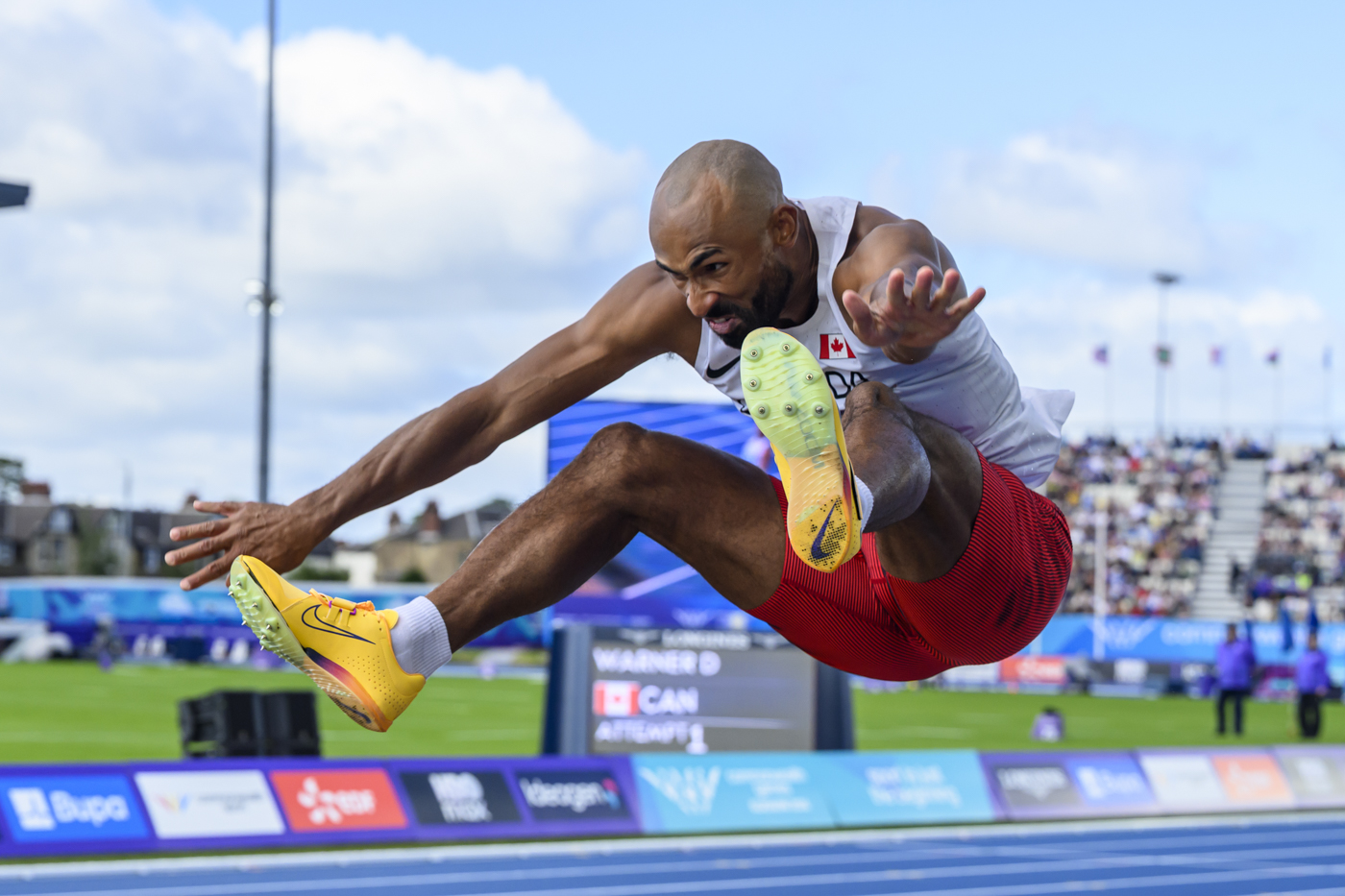
The last time anyone other than Damian Warner or Lindon Victor won a Commonwealth Games decathlon was in 2010.
The last time anyone other than a Canadian or Grenadian won the title was even further back in time, in 2006.
And in Glasgow in 2026, the chances of either Canadian 2021 Olympic champion Damian Warner or Grenadian 2024 Olympic bronze medallist Lindon Victor continuing that streak are pretty darn good.
First place after three events
When Damian Warner has a bad day, his bad day is still probably better than most others’ best day. While, at 36, he may not be in the shape which took him to the rarified air of the 9000-point club in 2021, he can still bang out 8400 and 8500+ decathlons to order, scores way beyond what anyone else (other than his buddy Victor) in the Commonwealth decathlon field has achieved in their careers.
This year in Götzis, Warner set the scene for competition with a 10.28s 100m and 7.73m long jump, a combination of marks for which most decathletes would sacrifice a limb. Although his second day went awry, he still scored 8497 points.
The Canadian veteran was already ahead of that profile after two events today in Glasgow, 10.21s and 7.77m for the opening sprint and jump respectively. The combined wind behind those marks was a 7.6 metres per-second-level hoolie, but that matters not for a championship competition.
His shot was a little down, usually logging a mark starting with a 15 than a 13 (13.84m) but after three events he is 80 points ahead of his nearest rival.
Warner won the competition the last time it was held in Glasgow, scoring 8282 to win in Hampden Park in 2014.
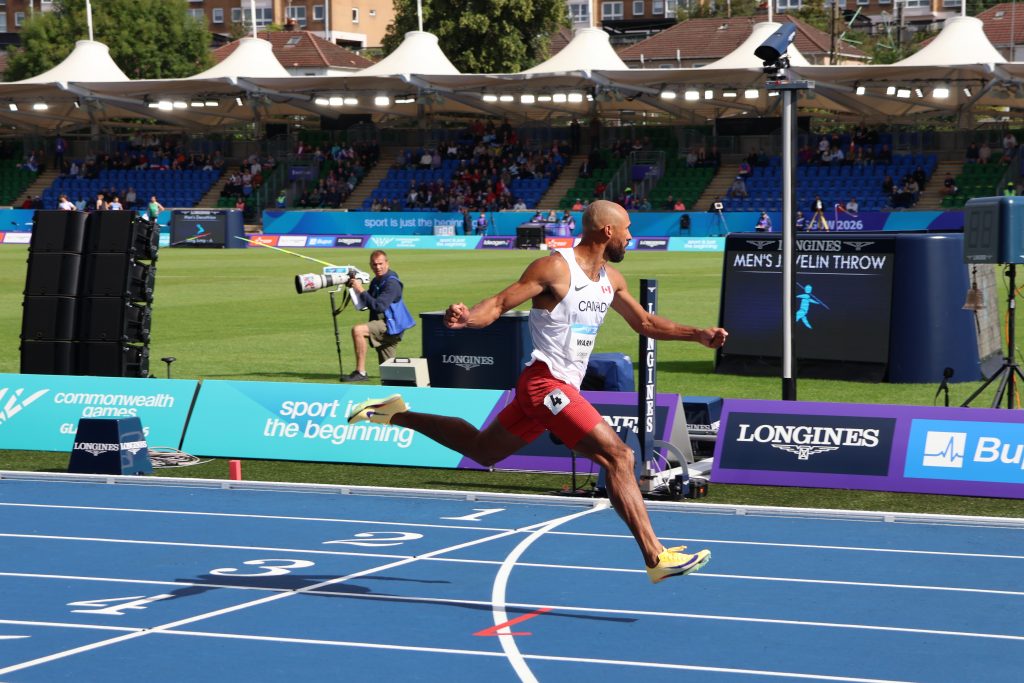
Second place after three events
Lindon Victor is the reigning Commonwealth champion, winning both Birmingham in 2022 and in Gold Coast in 2018.
In Birmingham, he had a close match with Cedric Dubler of Australia, chuckling about the inconvenience of constantly swapping leader bibs as the Australian surged ahead in the jumps, while Victor regained ground in the throws.
Since that gold medal in 2022, the Grenadian has improved to the highest levels of decathlon, with a bronze medal at the World Championships in Budapest in 2023, a bronze medal at the Olympic Games in Paris in 2024, and a personal best of 8756.
2026 has been tentative for Lindon, competing only in individual events as he navigates some issues. But 10.54s in the 100m (fastest behind Damian), 7.20m in the long jump and a big throw of 16.09m have placed him in second after three events.
While Damian’s decathlon profile is anchored on his speed, Lindon’s decathlon profile is structured around his throws. His second day brings an enormous discus (50m+) and javelin (70m+).
Third place after three events
Sammy Ball of England is in third place after three events, with good performances in the 100m (10.56s) and long jump (7.49m) to help him on his way. Both were wind-assisted, but all the 100m heats and most of the long jump attempts were also so boosted, so the relative performances remain relevant.
Ball is one of three English athletes to break 8000 points for the first time in the last few years. The others are Lewis Church, also competing, and Jack Turner, now retired.
Sammy’s performance at championships has been hampered by unfortunate timing with injuries, taking him out of contention for age group titles at EU20 and EU23 level, when he would have otherwise expected to collect a medal.
His breakthrough performance of 8100 points came at Götzis in 2025, where he was named Rookie of the Year. Ball’s participation in various competitions this year was postponed due to a series of niggling injuries, but so far in Glasgow he looks to be in very good shape.
He has a good mix of strengths across days, with room to improve in the pole vault, although that matters less outside a global championships or major meet.
Fourth place after three events
Jami Schlueter of Nigeria is in fourth place after three events, just 13 points behind Ball. It’s been a grand year for Schlueter so far, scoring over 8000 points for the first time, and racking up marks for Nigeria, to whom he transferred from Great Britain and Northern Ireland officially in November 2025.
Following the end of his NCAA college career (where he was at University of Washington) Schlueter is now training with Lindon Victor in Texas, under 2000 Olympic bronze medallist Chris Huffins and Marissa Chew. That squad also includes Joel McFarlane of Scotland, and Kendrick Thompson of The Bahamas (who did not start the competition).
Schlueter’s progress has been outstanding this year, setting personal bests in almost every discipline. He has started well in Glasgow, with 10.70s in the 100m, 7.16m in the long jump and a very good 15.35m in the shot.
Fifth place after three events
In fifth place after the morning session, lies India’s Tejaswin (TJ) Shankar. Originally a high jumper – in fact he won bronze for India at the 2022 Games – he tried out combined events as part of a bet with his training partner at Kansas State University, the New Zealand decathlete Aaron Booth.
Shankar brings a high jump personal best of 2.29m to the competition, although that should always be caveated in a decathlon by the fatigue of three events which have gone before.
The world best for a high jump in an 8000+ decathlon belongs to Christian Schenk, who leaped 2.27m in an 8400+ decathlon at the Olympics in Seoul in 1988.
The less relevant outright world best, in a 7000+ decathlon (which means much lower marks in all other events) is 2.28m by Derek Drouin in a 7150 decathlon.
Shankar’s best in a decathlon so far has been 2.25m, in his 8000 point score this year. He was originally also entered for the individual high jump in Glasgow but retired early on when he felt some pain in a recurring knee injury.
Watch the standings turn on their head in the fourth event after Shankar jumps. Only his pole vault, the most technical of events which he came to late as an athlete, remains a weak point for him at 4.35m. So the Indian’s objective in the high jump will be to put as much vertical space as possible between him and his competitors, to cushion him for the weaker event to come on day two.
Sixth place after three events
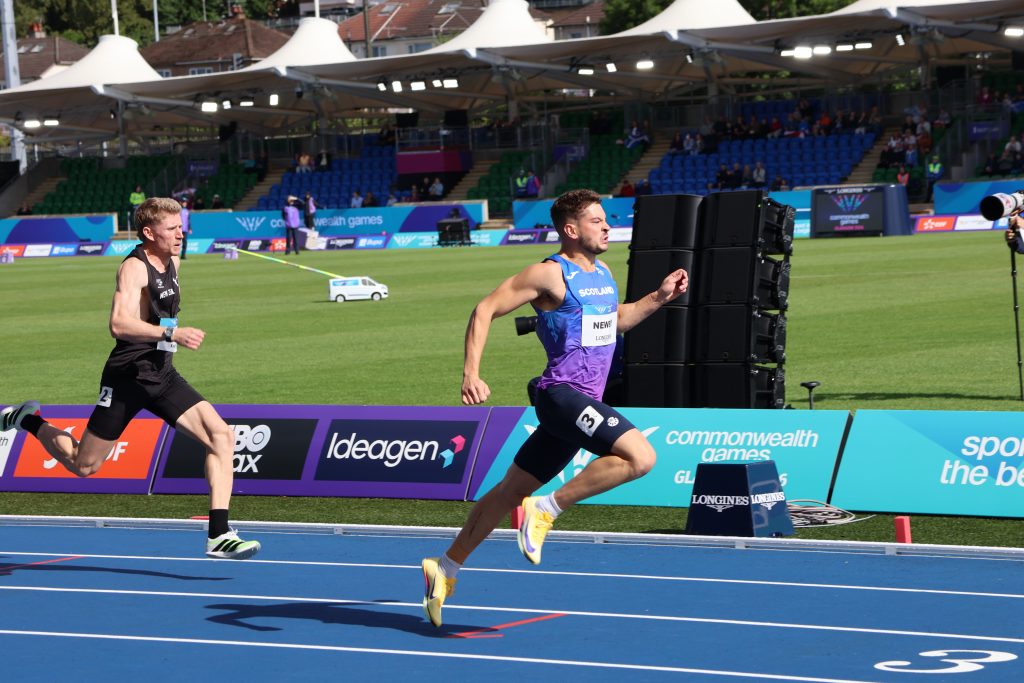
In sixth place, Scotland’s new decathlon star Callum Newby is 51 points behind TJ Shankar.
In 2026, Newby has broken both the Scottish national indoor heptathlon record, and the national decathlon record. The latter came at the Bryan Clay Invitational in Azusa in April, under the watchful eye of none other than Damian Warner himself, who was participating in a few individual events.
Newby’s goal was to achieve the Scottish Commonwealth Games qualification mark, which he did with 7867, but 8000 points also seem well within his reach. The former cage-fighting physics graduate is by far the best pole vaulter in the field – no-one else has ever cleared 5m, and his best is 5.15m – so Newby has some tricks up his sleeve on day 2.
So far Newby has had a brilliant start to his home decathlon. His 100m mark of 10.76s was 0.2 seconds faster than his PB time (although not an official PB due to the +4.3m wind), and his long jump of 7.45m was within a centimetre of his best although, again, wind assisted. And his shot of 13.04m, one of the events where is still improving, was a solid effort against his lifetime best of 13.58m.
Seventh place after three events
In seventh place, 74 points behind Newby, England’s Lewis Church has started his decathlon well. In a major decathlon, he is typically a climber over ten events, stalking the faster decathletes who dominate with their fast times and big jumps in the early events.
In 2022, Church delivered a brilliant performance at Multistars to achieve the England qualification mark for the Birmingham Commonwealth Games. But he wasn’t selected.
Since then, Church has scored over 8000 points, twice. His entry into decathlon in 2026 has been a little subdued thus far, managing some injuries to score 7666 in Götzis, but the Commonwealth Games have been the priority.
With a lifetime best of 11.00s in the 100m, 11.14s was a good start, wind or no wind. And then he equalled his PB of 7.10m in the long jump, once with a legal wind and again with a windy wind. He followed that with a solid 14.56s shot, behind only Victor and Schlueter. Those points collected may not place him at the top of the standings in day 1, but they build a foundation for his stronger events to come.
Eighth place after three events
The second Scottish decathlete in the field (such riches!) is Joel McFarlane, who trains with Victor and Schlueter in Texas. He lies 58 points behind Church in eighth place after three events.
His decathlon PB is 7661, and the big improvement still to come is in his hurdles. As a decathlete of relatively compact build, the adaptation to senior heights is still work in progress for McFarlane. That’s a challenge which 2024 Olympic champion Markus Rooth also articulated at a similar point in his career, and when that comes for Joel, a significant number of points will be unlocked.
His start in the competition has been up and down, a 10.85s sprint (just a few hundredths short of his best), a 6.98m long jump, and a 13.05m shot.
Ninth to twelfth place after three events
In ninth place, multiple New Zealand decathlon champion and 2022 Oceania Champion Max Atwell is 25 points behind McFarlane, with a decent series of marks across the first three events. Atwell’s lifetime best decathlon is 7822.
In tenth place, Evan Campbell is representing Jersey, and he is also the training partner of Callum Newby. Campbell had a rollercoaster ride to qualification for the Games, but with 11.32s (wind-assisted) he ran faster than his 100m PB to settle into the competition. His shot was very good too, with 14.43m.
In eleventh place, Edwin Too of Kenya comes to the Championships on the back of second place at the 2026 African championships. With the exception of his shot, he has a series of best marks which suggest he has a decathlon score much higher than his PB of 7305 to come.
And in twelfth place, Max Teuruaa is representing the Cook Islands. His PB is 6337. He transferred allegiance from New Zealand to the Cook Islands in 2023, and holds the national record in decathlon, hurdles (indoor and out), pole vault, in contributions to various relays and in U20 decathlon. He set his national record while competing as a guest at the New Zealand championships earlier this year.
He had a brilliant long jump, jumping way beyond his PB distance (albeit wind-aided) and threw a PB of 11.31m in the shot.
Overall scores after three events
| Damian Warner (CAN) | 2765 |
| Lindon Victor (GRN) | 2685 |
| Sammy Ball (ENG) | 2605 |
| Jami Schlueter (NGR) | 2592 |
| TJ Shankar (IND) | 2558 |
| Callum Newby (SCO) | 2507 |
| Lewis Church (ENG) | 2431 |
| Joel McFarlane (SCO) | 2373 |
| Max Atwell (NZ) | 2348 |
| Evan Campbell (JER) | 2285 |
| Edwin Too (KEN) | 2242 |
| Max Teuruaa (COK) | 2115 |
How to support my work: If you enjoyed this report and would like to to support my work, feel free to fuel my coverage with a coffee at ko-fi.com/thedecathlonwriter
WRITTEN BY GABBY PIERACCINI
PS. The Canadian who won the 2010 Commonwealth Games decathlon title was Jamie Adjetey-Nelson of Canada, and the 2006 winner was Dean Macey of England.
